
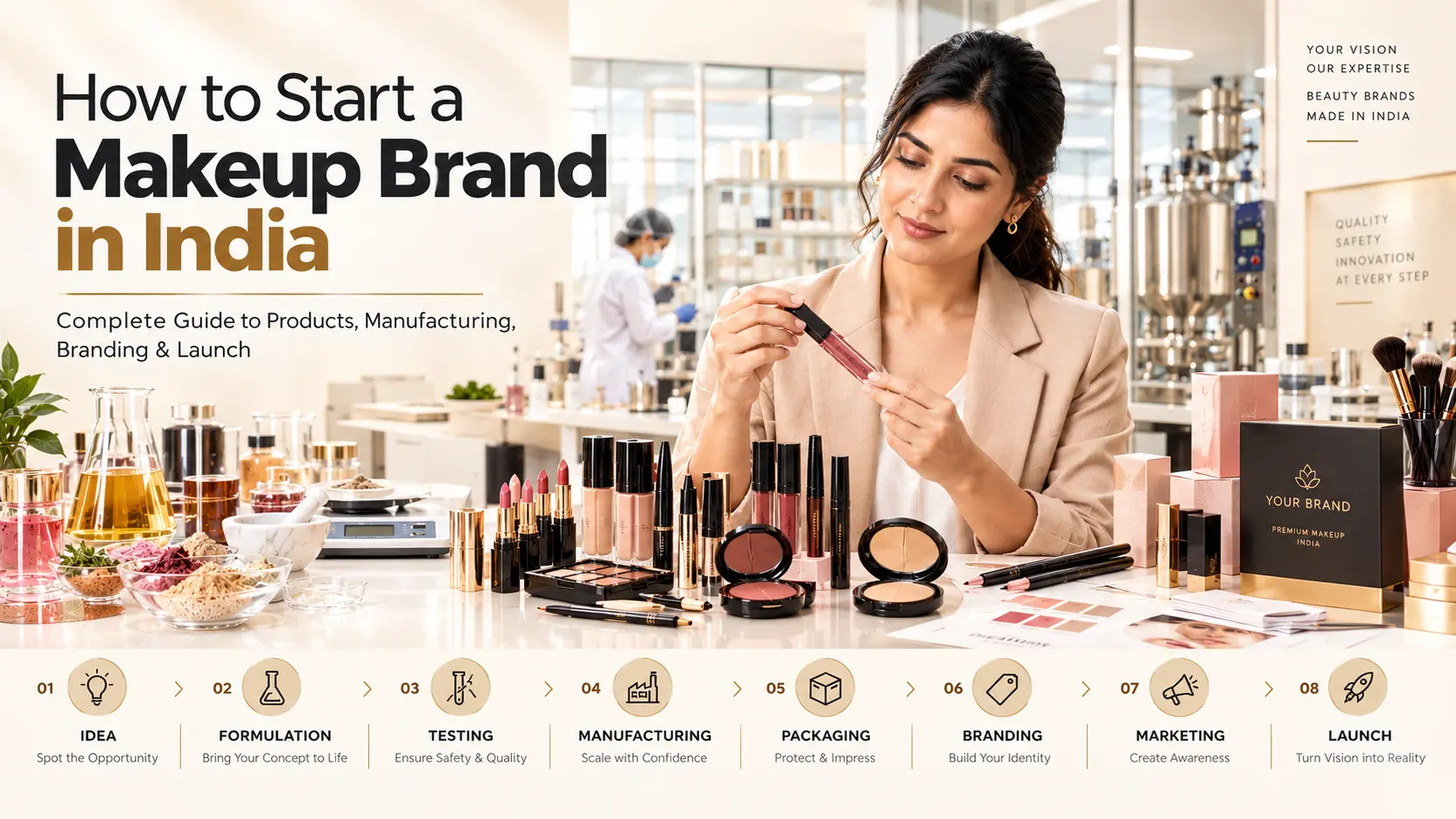
Starting a makeup brand in India can be a profitable opportunity for entrepreneurs, beauty professionals, retailers, influencers, and businesses looking to enter the growing cosmetics market. From choosing the right makeup products to developing formulations, packaging, regulatory compliance, manufacturing, branding, and digital marketing, there are several important steps to plan before launching.
The good news is that you do not necessarily need your own manufacturing facility to start a makeup brand. Working with an experienced private label or third-party makeup manufacturer in India can allow you to develop and launch products under your own brand while outsourcing manufacturing.
This complete guide explains how to start a makeup brand in India, including the major steps, estimated considerations, product ideas, manufacturing options, branding strategies, and marketing techniques.
Quick Answer: How Do You Start a Makeup Brand in India?
To start a makeup brand in India, follow these key steps:
- Research the Indian makeup market and identify your target customers.
- Choose a specific makeup niche and product category.
- Select the makeup products you want to launch.
- Develop or select suitable formulations.
- Choose a reliable private-label or third-party makeup manufacturer.
- Finalize product testing, quality requirements, and specifications.
- Create your brand name, identity, packaging, and positioning.
- Complete applicable regulatory and business requirements.
- Develop your website and e-commerce presence.
- Build a marketing strategy across Google, Instagram, YouTube, marketplaces, and other channels.
- Launch your products with a focused marketing campaign.
- Track sales, customer feedback, repeat purchases, and product performance.
A private-label or third-party manufacturing model can be a practical starting point because it allows entrepreneurs to focus on branding, product selection, sales, and marketing rather than building their own manufacturing infrastructure.
1. Understand the Indian Makeup Market
Before creating products, understand who you want to sell to and what customers are looking for.
The Indian beauty market includes a wide range of consumers with different skin tones, skin types, preferences, budgets, and makeup habits.
Potential customer segments include:
- Teenagers and young adults
- Working professionals
- Makeup enthusiasts
- Bridal makeup customers
- Professional makeup artists
- College students
- Men interested in grooming and cosmetics
- Premium beauty consumers
- Budget-conscious consumers
- Online beauty shoppers
- Influencer-led beauty audiences
Instead of trying to sell everything to everyone, consider building your makeup brand around a clearly defined customer.
Example
Instead of:
“We sell makeup products for everyone.”
Consider:
“We create affordable, everyday makeup products designed for Indian skin tones and Indian beauty routines.”
A specific positioning can make branding, product development, content creation, and advertising easier.
2. Choose Your Makeup Brand Niche
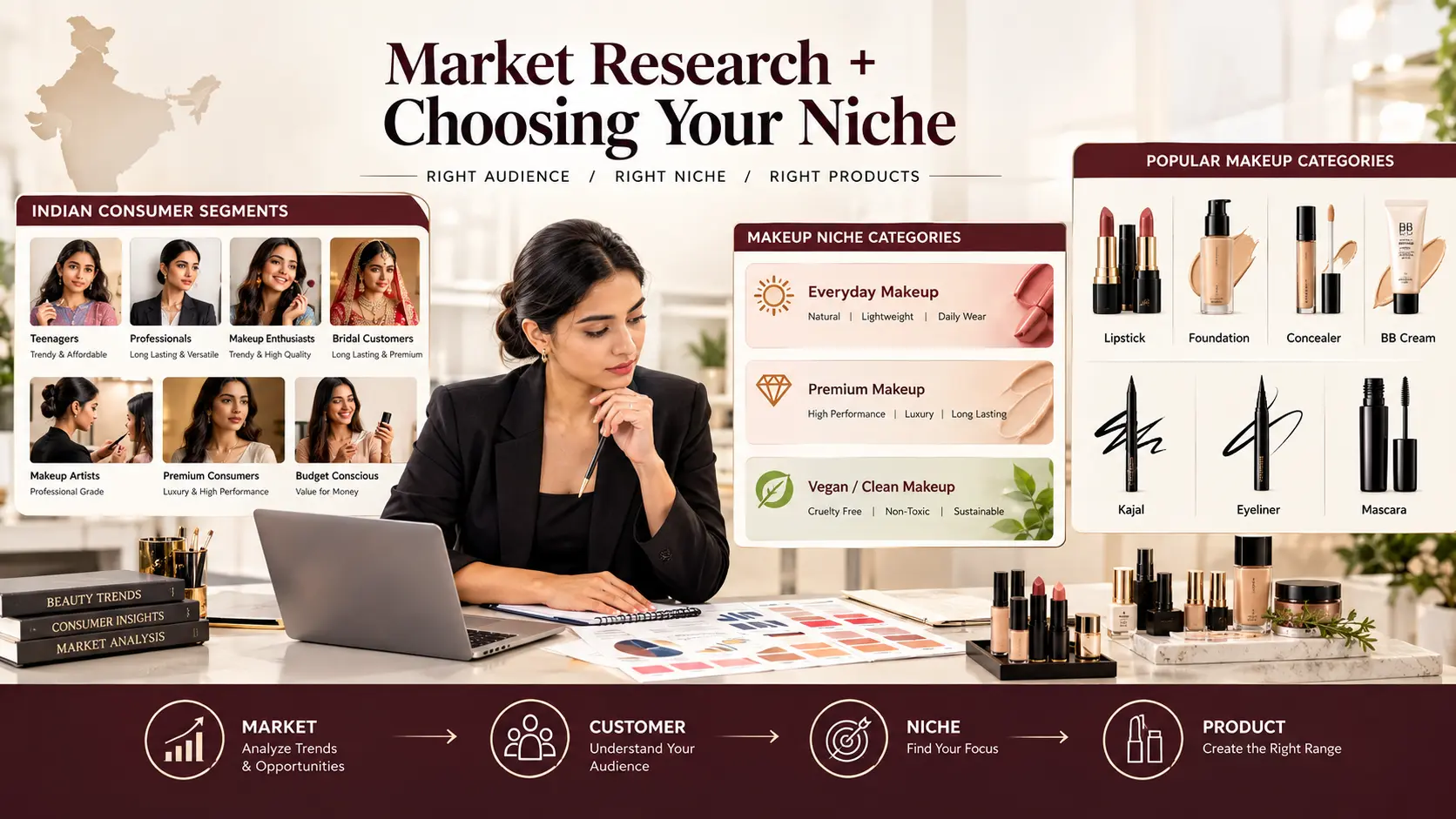
Your niche determines the type of products you develop and the audience you target.
Some potential makeup niches in India include:
Everyday Makeup
Products designed for simple daily routines:
- BB creams
- Foundations
- Concealers
- Compact powders
- Lipsticks
- Lip tints
- Kajal
- Eyeliners
- Mascara
Premium Makeup
A premium positioning may focus on:
- Luxury packaging
- Sophisticated formulations
- High-performance products
- Premium ingredients
- Professional-quality makeup
Vegan or Clean-Positioned Makeup
Some brands focus on ingredient preferences and specific formulation philosophies.
If you use claims such as “vegan,” “natural,” “organic,” “clean,” or similar terms, make sure the claim can be appropriately substantiated.
Long-Lasting Makeup
Products can be positioned around specific performance characteristics such as:
- Long wear
- Transfer resistance
- Sweat resistance
- High pigmentation
- Lightweight texture
Claims should be supported by appropriate product testing and documentation.
Makeup for Indian Skin Tones
India has considerable diversity in skin tones and undertones. Developing products with a thoughtful shade range can become an important point of differentiation.
3. Decide Which Makeup Products to Launch
One of the biggest mistakes new beauty entrepreneurs make is launching too many products at once.
A focused initial collection can be easier to manufacture, market, test, and manage.
Popular Makeup Product Categories
- Foundation
- Concealer
- BB cream
- CC cream
- Compact powder
- Loose powder
- Blush
- Highlighter
- Bronzer
- Contour products
- Kajal
- Eyeliner
- Mascara
- Eyeshadow
- Eyebrow products
- Lipstick
- Liquid lipstick
- Lip gloss
- Lip balm
- Lip tint
- Lip liner
Example Starter Collection
A new brand could begin with:
- 1–2 face products
- 2–3 lip products
- 1 eye product
- 1 multipurpose product
Once the brand understands customer demand, additional products and shades can be introduced.
4. Identify Your Unique Selling Proposition
Your USP answers a simple question:
Why should a customer choose your makeup brand instead of another brand?
Possible differentiators include:
- Makeup designed for Indian skin tones
- Affordable premium makeup
- Professional makeup performance
- Lightweight textures
- Long-wear formulations
- Inclusive shade ranges
- Travel-friendly packaging
- Minimalist beauty
- Specific consumer segment
- Innovative product formats
Your USP should be reflected consistently in your:
- Product formulations
- Packaging
- Website
- Social media
- Advertising
- Product descriptions
- Photography
- Customer experience
5. Choose a Private Label or Third-Party Makeup Manufacturer
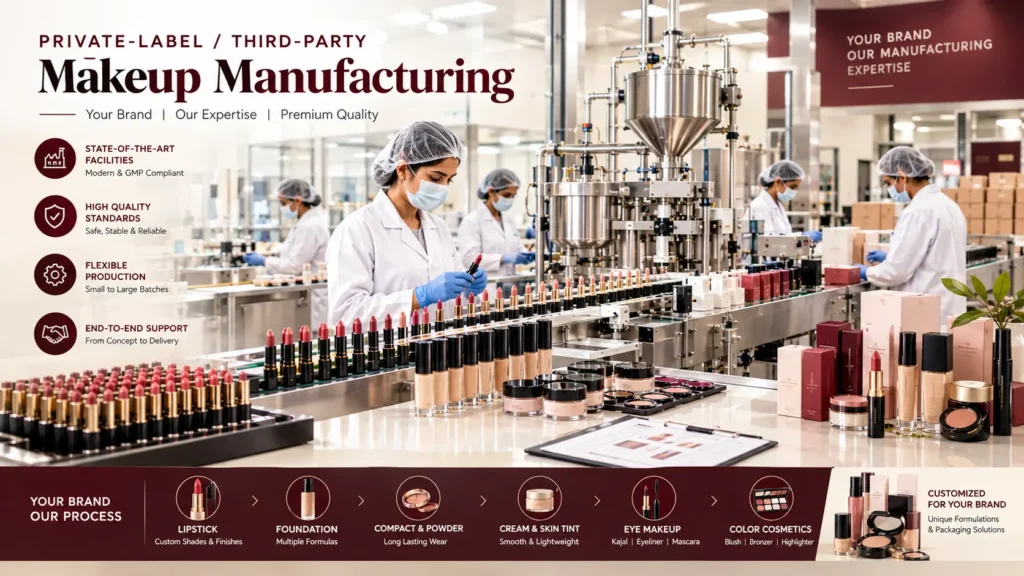
You do not have to build your own cosmetics manufacturing facility to start a makeup brand.
A private-label or third-party cosmetics manufacturer can manufacture products for your brand according to agreed specifications.
This can significantly simplify the process for entrepreneurs who want to concentrate on:
- Branding
- Product strategy
- Marketing
- Sales
- Distribution
- Customer acquisition
An experienced manufacturer may assist with areas such as:
- Product formulation
- Manufacturing
- Filling
- Packaging
- Quality processes
- Product documentation
- Product customization
For businesses entering the market for the first time, selecting the right manufacturing partner is one of the most important decisions.
What Should You Ask a Makeup Manufacturer?
Before selecting a manufacturer, ask about:
- Manufacturing capabilities
- Product categories
- Minimum order quantities
- Custom formulation options
- Private-label options
- Packaging options
- Product testing
- Quality-control procedures
- Manufacturing certifications
- Documentation
- Lead times
- Sampling process
- Scalability
- Export capabilities
Do not select a manufacturer based only on price. Product consistency, quality, documentation, communication, and scalability are equally important.
6. Develop Your Makeup Formulation
Your product formulation is one of the most important parts of your brand.
Depending on your business model, you may choose:
Ready Formulation
You select an existing formulation offered by a manufacturer and customize aspects such as:
- Brand
- Packaging
- Shade
- Fragrance, where applicable
- Product presentation
This can help reduce development time.
Customized Formulation
A manufacturer develops or modifies a formulation according to your specifications.
Customization may involve:
- Texture
- Finish
- Shade
- Coverage
- Performance characteristics
- Ingredient preferences
- Packaging format
Customized products may require additional development time and testing.
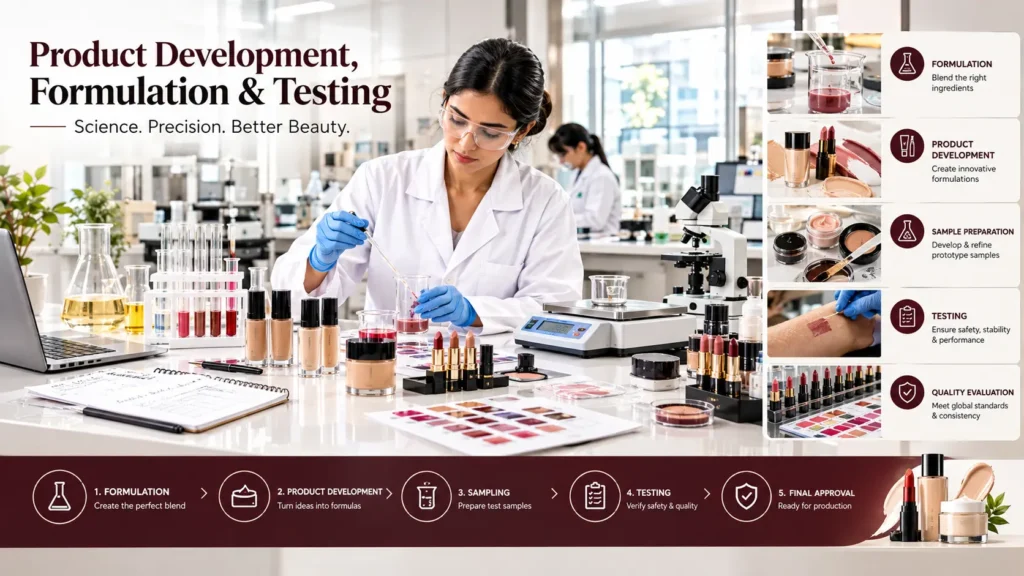
7. Test Your Makeup Products Before Launch
Never rely only on how a product looks in a sample.
A professional product-development process should consider appropriate testing and quality evaluation.
Depending on the product, this can include evaluation of:
- Stability
- Microbiological quality
- Physical characteristics
- Packaging compatibility
- Appearance
- Texture
- Odour
- Performance
For makeup products, shade consistency can also be particularly important.
For example, if you launch a foundation in multiple shades, customers should receive consistent shade performance from batch to batch.
8. Build Your Makeup Brand Identity
Your brand identity is more than a logo.
A strong makeup brand should have a consistent visual and verbal identity.
Important elements include:
- Brand name
- Logo
- Brand colors
- Typography
- Packaging design
- Photography style
- Product naming
- Brand story
- Tone of voice
- Website design
- Social media identity
Example
A premium makeup brand might use:
- Elegant typography
- Minimal packaging
- Sophisticated photography
- Premium product names
- Luxury-oriented messaging
An affordable youth-focused brand may use:
- Bold colors
- Energetic photography
- Short-form video
- Casual language
- Trend-driven product names
Your branding should match the customer you want to attract.
9. Create Attractive Makeup Packaging
Packaging plays an important role in cosmetics because customers often evaluate beauty products visually before purchasing.
Your packaging should communicate:
- Brand identity
- Product name
- Product type
- Shade or variant
- Net quantity
- Required product information
- Manufacturer/marketer details where applicable
- Batch information
- Relevant dates
- Applicable statutory declarations
Packaging should also be practical, durable, and suitable for transportation and storage.
For e-commerce brands, packaging should withstand shipping and handling.
10. Understand Cosmetic Regulatory Requirements in India
Before selling cosmetics in India, you need to understand the applicable regulatory framework.
Cosmetics sold in India are subject to requirements under India’s cosmetics regulatory system, including the Drugs and Cosmetics Act, 1940 and Cosmetics Rules, 2020, along with other applicable legal requirements.
Requirements can vary depending on factors such as:
- Product type
- Manufacturing arrangement
- Manufacturer
- Import status
- Product claims
- Ingredients
- Packaging
- Business structure
For this reason, regulatory requirements should be verified for your specific products before commercial launch.
Do not make unsupported claims such as:
- “Cures acne”
- “Treats pigmentation”
- “Permanently removes wrinkles”
- “Guaranteed skin whitening”
Cosmetic claims should be appropriate for the product and supported by evidence where required.
11. Register and Protect Your Brand Name
Before investing heavily in packaging and marketing, check whether your proposed brand name is available.
Consider checking:
- Domain availability
- Social media handles
- Trademark availability
- Similar existing brand names
A trademark strategy can help protect your brand identity as the business grows.
It is advisable to obtain professional legal advice regarding trademark classification and registration.
12. Set Your Makeup Brand Pricing
Your selling price should not be based only on manufacturing cost.
Consider your complete unit economics.
Example Cost Structure
Your product cost may include:
Manufacturing + Packaging + Testing + Shipping + Warehousing + Platform Fees + Marketing + Taxes + Other Business Costs = Total Cost
You then need to determine a selling price that provides sufficient margin to support:
- Advertising
- Discounts
- Distributor margins
- Marketplace commissions
- Returns
- Influencer marketing
- Customer acquisition
- Future product development
Important
A low manufacturing price does not automatically create a profitable makeup brand.
The goal should be healthy unit economics, not simply the lowest possible product cost.
13. Decide Where You Will Sell Your Makeup
You can sell through multiple channels.
Your Own Website
An e-commerce website gives you greater control over:
- Branding
- Customer experience
- Customer data
- Product presentation
- Promotions
Online Marketplaces
Depending on your strategy, marketplaces can provide access to a large customer base.
Social Commerce
Instagram, Facebook, YouTube, and other platforms can help generate product discovery and sales.
Offline Retail
Potential channels include:
- Beauty stores
- Cosmetic retailers
- Salons
- Spas
- Makeup artists
- Distributors
- Department stores
A combination of online and offline channels can be considered as the brand grows.
14. Build a Professional Makeup Website
Your website should do more than display products.
Important pages can include:
- Home
- About Us
- Shop
- Product pages
- Contact
- Shipping policy
- Return/refund policy
- Privacy policy
- Terms and conditions
- FAQs
- Blog
Optimize Product Pages for SEO
Each product page should have:
- Search-focused title
- Clear product description
- Relevant keywords
- Unique content
- Optimized images
- Descriptive image ALT text
- FAQs
- Internal links
- Product structured data where appropriate
- Clear calls to action
For example, instead of a generic product title:
Lipstick
use a descriptive title that communicates the product’s relevant attributes.
15. Create an SEO Strategy for Your Makeup Brand
SEO can help your brand attract customers who are actively searching for makeup products.
Commercial Keywords
Examples include:
- Buy lipstick online
- Best foundation for Indian skin
- Matte lipstick
- Long lasting lipstick
- Makeup products online
- Lip tint for Indian skin
- Waterproof eyeliner
- Private label makeup manufacturer India
- Third party makeup manufacturer India
- Makeup manufacturer in India
Informational Keywords
Create educational content around questions such as:
- How to choose foundation shade
- How to apply concealer
- How to choose lipstick for skin tone
- How to apply makeup for beginners
- Difference between BB cream and foundation
- How to make makeup last longer
- How to build a makeup routine
This creates opportunities to attract users at different stages of the buying journey.
16. Use GEO Optimization for AI Search
SEO is no longer limited to traditional search engines.
Generative Engine Optimization (GEO) helps make content easier for AI-powered search and answer systems to understand and use.
For a makeup brand, structure important information so that questions can be answered clearly.
Example
Instead of writing only:
“Our foundation provides excellent coverage.”
Use a clearer structure:
What is a foundation?
Foundation is a makeup product used to create a more even-looking complexion and provide varying levels of coverage.
How do you choose a foundation shade?
Choose a shade that closely matches your skin tone and consider your undertone when selecting the most suitable shade.
This question-and-answer structure makes information easier for both users and search systems to understand.
GEO Best Practices
Use:
- Direct answers
- Clear H2 and H3 headings
- Short paragraphs
- Definitions
- FAQs
- Step-by-step instructions
- Comparison tables
- Specific product information
- Authoritative references
- First-hand expertise
- Structured data where appropriate
17. Build Your Social Media Presence
Makeup is highly visual, making social media particularly valuable for brand discovery.
Focus on platforms that match your target audience and content capabilities.
Content ideas:
- Product demonstrations
- Makeup tutorials
- Before-and-after content
- Shade demonstrations
- Reels
- Customer reviews
- Influencer collaborations
- Behind-the-scenes manufacturing
YouTube
Create:
- Makeup tutorials
- Product reviews
- Ingredient education
- Shade guides
- Beginner makeup tutorials
- Product comparisons
- Founder stories
- Manufacturing videos
Useful for:
- Product promotion
- Community building
- Retargeting
- Educational content
- Customer engagement
For a cosmetics manufacturing or B2B brand, LinkedIn can be valuable for:
- Private-label manufacturing
- Third-party manufacturing
- Business partnerships
- Export opportunities
- Manufacturing expertise
18. Work With Beauty Influencers
Influencer marketing can help new makeup brands build awareness and trust.
You do not necessarily need celebrity influencers.
Micro-influencers can be useful because they may have:
- Highly engaged audiences
- Strong niche relevance
- Lower collaboration costs
- More authentic community interaction
Consider working with creators who match your target customer rather than selecting influencers only based on follower count.
Ask creators to demonstrate the actual product rather than simply displaying it.
19. Create Educational Beauty Content
Content marketing can become a long-term acquisition channel.
Possible blog topics include:
- How to Choose the Right Foundation Shade
- Foundation vs BB Cream: What’s the Difference?
- How to Apply Concealer Correctly
- How to Make Lipstick Last Longer
- Matte vs Glossy Lipstick
- How to Choose Makeup for Indian Skin Tones
- Beginner’s Makeup Routine
- How to Build a Makeup Kit
- Makeup Mistakes Beginners Should Avoid
- How to Start a Makeup Brand in India
Educational content can attract users before they are ready to purchase.
20. Launch With a Small, Focused Product Collection
Your first launch does not need to contain dozens of products.
A focused collection allows you to learn:
- Which products sell
- Which shades perform best
- Which marketing channels work
- What customers complain about
- Which products generate repeat purchases
- Which products have the highest margins
Then use those insights to expand.
Example Growth Strategy
Stage 1: Launch 3–5 products.
Stage 2: Identify best-selling products and shades.
Stage 3: Expand successful categories.
Stage 4: Introduce complementary products.
Stage 5: Build collections and complete makeup routines.
21. Track Your Makeup Brand's Performance
After launch, measure more than sales.
Important metrics include:
- Website traffic
- Conversion rate
- Average order value
- Customer acquisition cost
- Repeat purchase rate
- Product return rate
- Best-selling products
- Best-selling shades
- Social media engagement
- Email/SMS conversion
- Advertising ROAS
- Customer reviews
- Organic search traffic
These metrics help determine where to invest your next marketing rupee.
22. Common Mistakes to Avoid When Starting a Makeup Brand
- Launching Too Many Products
Start focused and expand based on demand.
- Choosing a Manufacturer Only on Price
Low cost can become expensive if product quality or consistency is poor.
- Ignoring Packaging
Packaging strongly influences beauty-product perception.
- Making Unsupported Claims
Cosmetic marketing claims should be responsible and appropriately substantiated.
- Ignoring Shade Diversity
For complexion products, shade selection can significantly affect customer satisfaction.
- Underestimating Marketing Costs
Manufacturing a product is only one part of building a brand.
- Not Testing Products Properly
Samples should be evaluated before large-scale production.
- Weak Product Photography
High-quality product visuals are essential for online sales.
- No SEO Strategy
Relying entirely on paid advertising can make customer acquisition expensive.
- No Long-Term Brand Positioning
A memorable brand needs a clear reason for customers to choose it repeatedly.
23. How Much Does It Cost to Start a Makeup Brand in India?
There is no single fixed cost for starting a makeup brand in India.
The investment depends on:
- Number of products
- Number of shades
- Product formulation
- Packaging
- Minimum order quantity
- Testing
- Branding
- Website development
- Inventory
- Marketing
- Photography
- Logistics
- Business and regulatory requirements
A small private-label launch can require significantly less infrastructure investment than establishing your own manufacturing facility.
The best approach is to prepare a detailed product-level budget before placing your first manufacturing order.
24. Private Label vs Own Manufacturing Facility
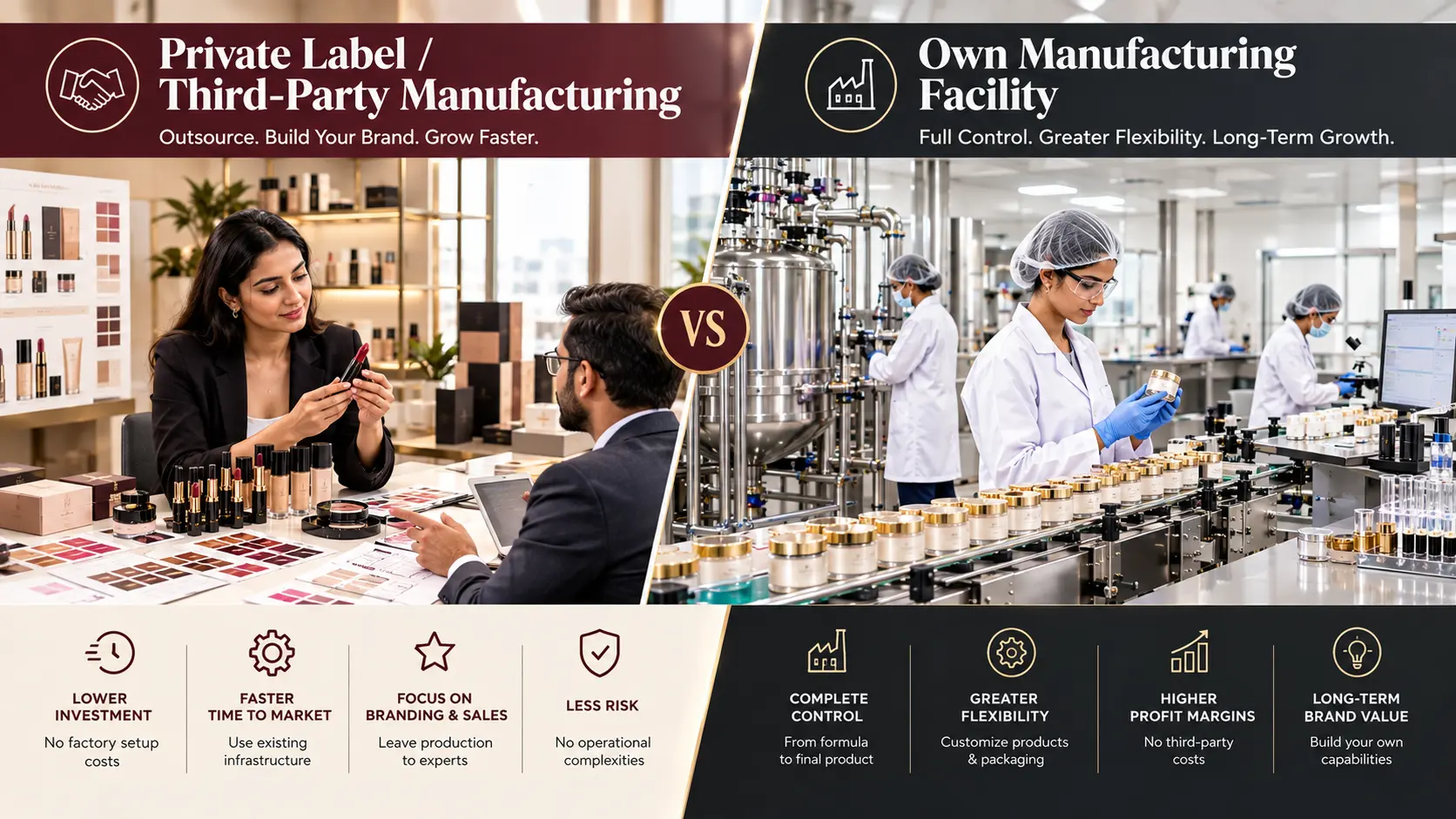
Factor | Private Label / Third-Party Manufacturing | Own Manufacturing |
Initial infrastructure | Lower | Higher |
Manufacturing facility | Not required by the brand owner | Required |
Product development | Manufacturer-assisted | Brand manages internally |
Operational complexity | Lower | Higher |
Control | Depends on manufacturer agreement | Greater direct control |
Scalability | Can be easier initially | Requires infrastructure planning |
Focus | Brand and marketing | Manufacturing + brand |
Suitable for | New and growing brands | Established manufacturers |
For many entrepreneurs, private-label or third-party manufacturing can be a practical way to enter the cosmetics market without immediately investing in a complete manufacturing operation.
25. How Fablay Cosmetics Can Help
Fablay Cosmetic Formulations provides private-label and third-party cosmetic manufacturing solutions for businesses looking to develop and launch cosmetic products.
With extensive experience in cosmetics manufacturing, Fablay works with brands, merchant exporters, and export houses seeking professionally manufactured cosmetic products.
Depending on the product and project requirements, the manufacturing process can involve:
- Product development
- Formulation
- Manufacturing
- Filling
- Packaging
- Quality processes
- Product customization
If you are planning to launch a makeup brand, selecting the right manufacturing partner can help you focus more effectively on building your brand, distribution, and customer base.
26. Frequently Asked Questions About Starting a Makeup Brand in India
Is it profitable to start a makeup brand in India?
A makeup brand can be profitable, but profitability depends on product-market fit, pricing, manufacturing costs, marketing efficiency, customer retention, distribution, and overall unit economics.
Can I start a makeup brand without my own factory?
Yes. Entrepreneurs can work with private-label or third-party cosmetic manufacturers instead of establishing their own manufacturing facility.
How do I find a makeup manufacturer in India?
Look for manufacturers with appropriate manufacturing capabilities, quality systems, documentation, testing processes, product-development support, suitable minimum order quantities, and experience with your required product category.
What makeup products should I launch first?
Start with products that fit your target audience and brand positioning. A focused collection of a few complementary products is often easier to test than a very large initial range.
Can I create my own makeup formulation?
Yes. Depending on your manufacturing partner and requirements, you may use an existing formulation or develop a customized formulation.
How important is packaging for a makeup brand?
Packaging is extremely important because it communicates brand positioning and influences the customer’s first impression. It should also provide the required product information and protect the product during storage and transportation.
Do I need a website for my makeup brand?
A website is highly recommended for building a direct-to-consumer presence, presenting your brand story, publishing educational content, selling products, and building long-term organic visibility.
How can I market a new makeup brand?
Use a combination of SEO, social media, influencer marketing, content marketing, paid advertising, email/SMS marketing, marketplace presence, customer reviews, and partnerships appropriate to your target audience.
What is private-label makeup manufacturing?
Private-label makeup manufacturing allows a business to sell cosmetic products under its own brand while a manufacturing partner produces the products according to an agreed formulation, specification, packaging, and production arrangement.
Conclusion: Start Your Makeup Brand With the Right Strategy
Starting a makeup brand in India requires more than creating a logo and putting a product on a website. A successful brand needs the right combination of product quality, market positioning, manufacturing, packaging, regulatory compliance, pricing, branding, distribution, SEO, and marketing.
For entrepreneurs who do not want to establish their own manufacturing facility, partnering with an experienced private-label or third-party makeup manufacturer in India can provide a practical route to developing and launching cosmetic products.
The best starting point is to define your target customer, select a focused product range, develop quality products, build a distinctive brand identity, establish reliable manufacturing, and create a strong digital marketing strategy.
Ready to build your own makeup brand?
Explore private-label and third-party cosmetic manufacturing solutions with Fablay Cosmetic Formulations and take the first step toward developing your own cosmetics brand in India.