
Have you ever wondered how a cosmetic product goes from an idea or formula to the finished product sitting on a retail shelf?
The cosmetic manufacturing process involves multiple stages, including product formulation, raw material selection, testing, batching, manufacturing, filling, packaging, quality control, and final dispatch.
For brands working with a private label or third-party cosmetic manufacturer, understanding this process is important because it helps you evaluate manufacturers, estimate timelines, control product quality, and make better decisions about your cosmetic brand.
In this guide, we explain the cosmetic manufacturing process step by step, from formulation and ingredient selection to the final finished product.
What Is Cosmetic Manufacturing?
Cosmetic manufacturing is the process of converting carefully selected raw materials and an approved product formulation into a finished cosmetic product that is ready for packaging, distribution, and sale.
Depending on the product, manufacturing may involve processes such as:
- Weighing and dispensing raw materials
- Mixing
- Heating and cooling
- Emulsification
- Homogenization
- Filling
- Capping
- Labeling
- Packaging
- Quality control
- Finished-product inspection
The exact manufacturing process varies according to the product.
For example, manufacturing a face wash is different from manufacturing a lipstick, serum, cream, shampoo, sunscreen, or liquid foundation.
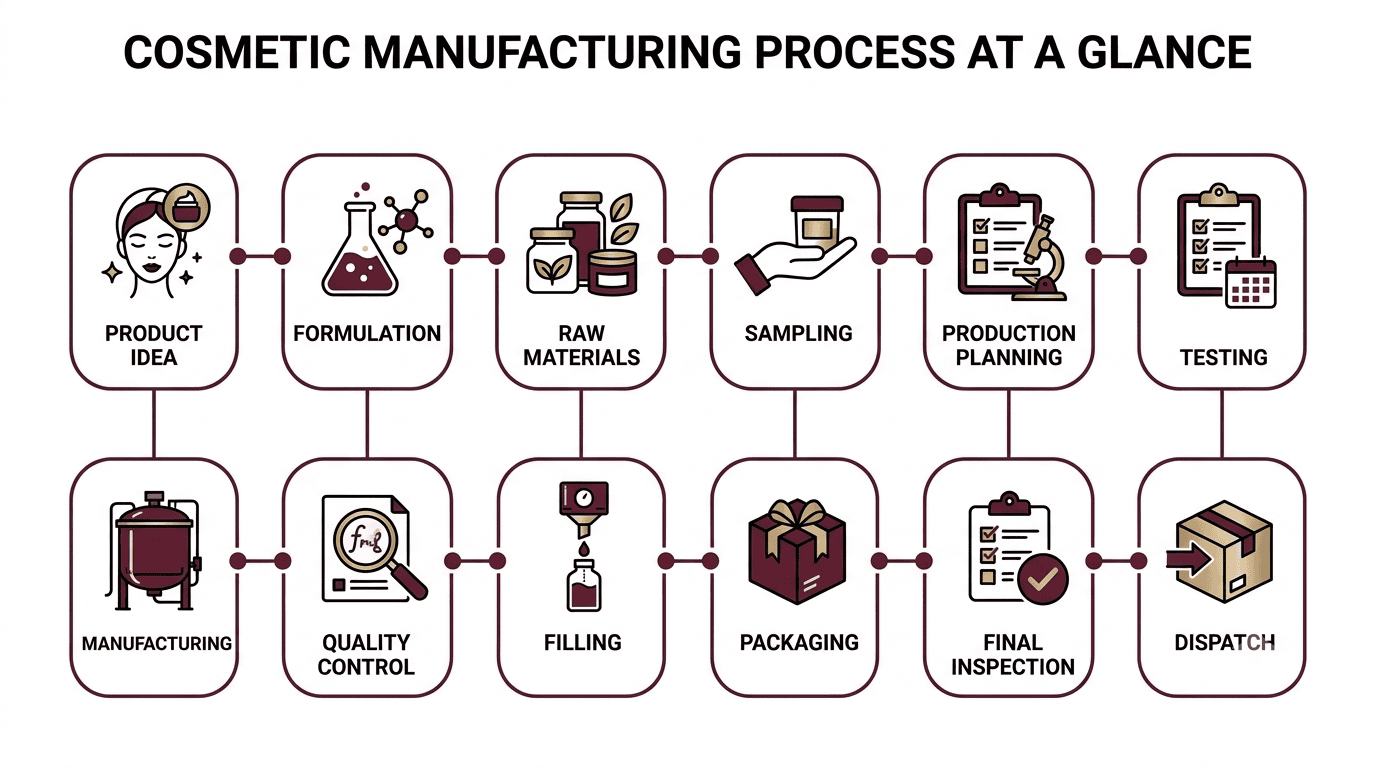
Cosmetic Manufacturing Process at a Glance
The typical journey from formula to finished product can be summarized as:
Product Idea → Formula Development → Raw Material Selection → Sampling → Testing → Production Planning → Weighing → Manufacturing → Quality Control → Filling → Packaging → Finished Product Inspection → Dispatch
Each stage plays an important role in delivering a consistent and market-ready cosmetic product
Step 1: Product Concept and Requirement
Every cosmetic product begins with an idea.
A brand may want to create a product based on:
- Customer demand
- Market trends
- A specific skin or hair concern
- A particular ingredient
- A desired texture
- A specific target audience
- A particular price point
- Existing product-market opportunities
For example, a brand might approach a cosmetic manufacturer with an idea for:
- Niacinamide face wash
- Hydrating serum
- Moisturizing cream
- Sunscreen
- Anti-dandruff shampoo
- Body lotion
- Lip balm
At this stage, the brand and manufacturer generally discuss the product’s intended use, positioning, formulation requirements, packaging, quantity, and target market.
Why product specifications matter
The more clearly the product requirements are defined, the easier it becomes to develop an appropriate formulation and manufacturing plan.
Step 2: Cosmetic Formulation Development
Once the product concept is finalized, the next stage is formulation development.
A cosmetic formulation determines what ingredients are used and in what proportions to achieve the desired product characteristics.
A formulation may need to address:
- Texture
- Appearance
- Fragrance
- Color
- Spreadability
- Skin feel
- Product performance
- Stability
- Compatibility with packaging
There are generally two approaches available to brands.
Private Label Formulation
The manufacturer may offer an existing formulation that can be manufactured under the brand’s identity, subject to the manufacturer’s capabilities and applicable requirements.
This can help reduce development time and initial product-development costs.
Custom Formulation
The manufacturer develops a formulation according to the brand’s specific requirements.
Custom formulation may involve additional R&D, testing, formulation trials, and development time.
For brands looking for a highly differentiated product, custom formulation can provide greater flexibility.
Step 3: Raw Material Selection
After the formulation is established, the required raw materials and ingredients are identified.
Depending on the product, these can include:
- Emollients
- Humectants
- Surfactants
- Emulsifiers
- Thickeners
- Preservatives
- Active ingredients
- Botanical extracts
- Fragrance
- Colorants
- Oils
- Butters
- Functional additives
- Purified water
The quality and specifications of raw materials can have a significant impact on the final product.
A professional cosmetic manufacturing process therefore requires appropriate controls over raw-material sourcing, specifications, storage, and handling.
Step 4: Sampling and Product Evaluation
Before large-scale manufacturing, the manufacturer may prepare a sample or laboratory batch.
This allows the brand and technical team to evaluate characteristics such as:
- Texture
- Color
- Fragrance
- Appearance
- Viscosity
- Application
- Skin feel
- Overall product characteristics
If changes are required, the formulation can be adjusted before moving toward commercial production.
This stage is particularly important for custom formulations.
Step 5: Testing and Stability Evaluation
Testing helps determine whether the formulation performs consistently and remains suitable under specified conditions.
Depending on the product and applicable requirements, testing may include areas such as:
- Physical characteristics
- Microbiological quality
- Stability
- Packaging compatibility
- Safety-related assessments
- Product specifications
What is stability testing?
Stability testing evaluates how a cosmetic product behaves over time under specified conditions.
It can help identify potential changes in:
- Color
- Odor
- Texture
- Viscosity
- Phase separation
- Appearance
- Microbiological quality
Testing requirements vary depending on the product and applicable regulatory and quality requirements.
Step 6: Packaging Selection
Packaging is selected according to the product’s characteristics, brand positioning, functionality, and market requirements.
Cosmetic packaging can include:
- Bottles
- Tubes
- Jars
- Pumps
- Droppers
- Airless containers
- Compacts
- Lipstick containers
- Sachets
- Outer cartons
Packaging is not simply about appearance.
The packaging needs to be appropriate for the product and compatible with the formulation.
For example, a serum packaged in a dropper bottle has different requirements from a shampoo packaged in a flip-top bottle.
Step 7: Production Planning
Once the formulation, specifications, packaging, quantity, and other requirements are finalized, the manufacturer prepares for production.
Production planning may include:
- Production quantity
- Raw material availability
- Packaging material availability
- Batch size
- Equipment requirements
- Production schedule
- Quality-control requirements
- Filling requirements
Good production planning helps minimize delays and maintain consistency between batches.
Step 8: Raw Material Weighing and Dispensing
Before manufacturing begins, the required raw materials are measured according to the approved manufacturing formula and production documentation.
Accurate weighing is critical because formulation ratios directly affect the characteristics of the finished product.
The materials are typically handled according to established manufacturing procedures and quality controls.
Step 9: Manufacturing and Mixing
The actual manufacturing process begins once the required materials have been prepared.
The specific process depends on the cosmetic category.
For a cream or lotion, for example, different phases may be prepared and subsequently combined through controlled mixing and emulsification.
For a liquid cleanser, surfactants, water, functional ingredients, and other components may be combined using a controlled sequence.
Manufacturing parameters can include:
- Mixing speed
- Mixing time
- Temperature
- Addition sequence
- Homogenization
- Cooling
- pH adjustment
The objective is to produce a consistent batch according to the approved formulation and manufacturing specifications.
Step 10: Homogenization and Emulsification
Some cosmetic products require additional processing to achieve the desired consistency and stability.
Homogenization
Homogenization helps distribute ingredients uniformly throughout the product.
Emulsification
Emulsification is particularly important for products containing oil and water phases, such as many creams and lotions.
The process helps create a stable and uniform emulsion with the desired texture and appearance.
Not every cosmetic product requires both processes.
Step 11: In-Process Quality Checks
Quality control does not begin only after manufacturing is complete.
In-process checks may be performed during production to ensure the batch meets defined specifications.
Depending on the product, checks may include:
- Appearance
- Color
- Odor
- pH
- Viscosity
- Weight
- Homogeneity
- Other product-specific parameters
If a batch does not meet the specified requirements, appropriate investigation and corrective action may be required before further processing.
Step 12: Filling the Cosmetic Product
Once the bulk product meets the required specifications, it moves to the filling stage.
Filling equipment transfers the cosmetic product into its designated packaging.
Examples include:
- Face wash into tubes or bottles
- Serum into dropper bottles
- Cream into jars
- Shampoo into bottles
- Lip products into their respective containers
Filling needs to be controlled to achieve the intended fill quantity and minimize contamination or packaging defects.
Step 13: Capping, Sealing and Labeling
After filling, containers are closed using the appropriate cap, pump, seal, or closure.
The products may then proceed through labeling and coding processes.
Depending on the packaging configuration, information may include:
- Product name
- Brand name
- Net quantity
- Batch information
- Manufacturing information
- Ingredient information
- Usage directions
- Required warnings
- Other applicable declarations
Cosmetic labeling requirements should be reviewed according to the applicable Indian regulations before commercial sale.
Step 14: Secondary Packaging
Some cosmetic products are placed inside secondary packaging such as cartons.
For example:
Serum → Glass bottle → Outer carton
or
Face cream → Jar → Outer carton
Secondary packaging can provide additional product protection while also carrying branding and required product information.
Step 15: Finished Product Quality Control
After filling and packaging, finished products undergo appropriate quality checks.
The objective is to verify that the finished product meets established specifications.
Checks may include:
- Appearance
- Packaging integrity
- Fill quantity
- Label correctness
- Batch information
- Product characteristics
- Microbiological quality, where applicable
- Other defined quality parameters
A structured quality-control process helps maintain consistency and reduce avoidable product defects.
Step 16: Final Inspection and Release
Before products are dispatched, the finished batch is reviewed according to the manufacturer’s quality procedures.
Only products that meet the applicable specifications and release requirements should proceed to distribution.
This stage provides an additional checkpoint between manufacturing and the market.
Step 17: Finished Product Dispatch
Once the batch has been released, the finished cosmetic products can be prepared for dispatch.
Depending on the business model, products may be sent to:
- The brand owner
- Distributor
- Warehouse
- E-commerce fulfillment center
- Retailer
- Export destination
The products are now ready to enter the brand’s supply chain.
How Long Does Cosmetic Manufacturing Take?
There is no single manufacturing timeline for every cosmetic product.
The overall timeline can depend on:
- Product type
- Existing vs custom formulation
- Number of formulation trials
- Testing requirements
- Packaging availability
- Raw material availability
- MOQ
- Production schedule
- Label and artwork approval
- Regulatory requirements
A private-label product using an existing formulation may generally move faster than a completely new custom formulation.
Brands should ask their manufacturer for a realistic timeline covering:
Sample approval → Packaging approval → Production → Filling → Quality control → Final dispatch
What Is Private Label Cosmetic Manufacturing?
Private label cosmetic manufacturing allows a business to sell cosmetic products under its own brand while working with a manufacturer to produce the products.
The manufacturer may provide:
- Existing formulations
- Product development
- Manufacturing
- Filling
- Packaging support
- Quality-control processes
- Product documentation
The brand owner can then focus on:
- Branding
- Marketing
- Sales
- Distribution
- Customer relationships
Private labeling can be an efficient entry model for entrepreneurs who want to build a cosmetics brand without establishing their own manufacturing facility.
What Is Third-Party Cosmetic Manufacturing?
Third-party cosmetic manufacturing refers to outsourcing the production of cosmetic products to an external manufacturer.
A brand provides its product requirements, and the manufacturing partner produces the products according to the agreed specifications and applicable requirements.
Third-party manufacturing can be useful for:
- New cosmetic startups
- Established brands
- Merchant exporters
- Export houses
- E-commerce brands
- Retail brands
- Businesses expanding their product range
Private Label vs Third-Party Manufacturing
Although the terms are sometimes used interchangeably, they can represent different business arrangements.
Factor | Private Label | Third-Party Manufacturing |
Formula | Often existing or semi-custom | Can be existing or custom |
Brand ownership | Brand owner | Brand owner |
Manufacturing | Outsourced | Outsourced |
Customization | Usually varies | Can be extensive |
Product development | Depending on manufacturer | Often available |
Best suited for | Faster brand launch | Flexible manufacturing requirements |
The exact meaning and services offered can vary between manufacturers, so brands should clarify the scope of services before placing an order.
How to Choose a Cosmetic Manufacturer in India
Choosing the right manufacturer is one of the most important decisions for a cosmetic brand.
Consider the following factors:
- Manufacturing Experience
Look for a manufacturer with experience relevant to your product category.
- Product Development Capability
If you require custom formulations, ask whether the manufacturer has appropriate R&D and formulation capabilities.
- Manufacturing Infrastructure
Evaluate whether the facility and equipment are appropriate for the products you intend to manufacture.
- Quality Control
Ask about quality-control procedures, testing, batch documentation, and product specifications.
- MOQ
Choose an MOQ that fits your launch budget and expected sales.
- Packaging Options
Check whether the manufacturer can support your desired packaging format.
- Lead Time
Understand the expected timeline from sample approval to finished-product dispatch.
- Documentation
Ensure the manufacturer can provide the documentation appropriate to your product and business requirements.
- Scalability
Your manufacturing partner should ideally be capable of supporting increased production as your brand grows.
Common Mistakes to Avoid When Manufacturing Cosmetics
New brands can face avoidable problems if they focus only on price.
Mistake 1: Choosing a Manufacturer Based Only on Price
The cheapest quotation may not provide the best overall value.
Mistake 2: Ignoring MOQ
A low unit price with an extremely high MOQ can create unnecessary inventory pressure.
Mistake 3: Skipping Product Testing
Appropriate testing and quality evaluation are important parts of responsible cosmetic manufacturing.
Mistake 4: Selecting Packaging Too Early
Packaging should be evaluated for suitability and compatibility with the formulation.
Mistake 5: Launching Too Many Products
Starting with a focused range can make inventory and marketing management easier.
Mistake 6: Making Unsupported Product Claims
Cosmetic marketing claims should be appropriate, substantiated where required, and compliant with applicable rules.
How Much Does Cosmetic Manufacturing Cost in India?
There is no fixed price for cosmetic manufacturing.
The cost can depend on:
- Product type
- Formula
- Ingredients
- Active ingredients
- Product size
- Manufacturing quantity
- MOQ
- Packaging
- Customization
- Testing
- Printing
- Shipping
For this reason, a manufacturer should provide a quotation based on the specific product requirements, rather than a generic per-unit figure.
How Fablay Can Help With Cosmetic Manufacturing
Fablay Cosmetic Formulations provides cosmetic manufacturing solutions for businesses looking to develop and manufacture products for their brands.
With extensive experience in cosmetics manufacturing, Fablay works with brands, merchant exporters, and export houses seeking quality-focused cosmetic manufacturing solutions.
Depending on your requirements, the manufacturing journey can involve:
Product Concept → Formulation → Sampling → Manufacturing → Quality Control → Filling → Packaging → Finished Product
Whether you are developing a new cosmetic product or expanding an existing product portfolio, selecting an experienced manufacturing partner can help streamline the process.
Ready to Develop Your Cosmetic Product?
If you are planning to launch a cosmetic brand or add new products to your existing range, discuss your requirements with Fablay Cosmetic Formulations.
Share your:
- Product category
- Desired formulation
- Target quantity
- Packaging preference
- Product size
- Customization requirements
and the manufacturing team can help determine the appropriate next steps.
Frequently Asked Questions About Cosmetic Manufacturing
What are the steps in cosmetic manufacturing?
The typical process includes product concept, formulation development, raw material selection, sampling, testing, production planning, weighing, manufacturing, quality control, filling, labeling, packaging, final inspection, and dispatch.
What is cosmetic formulation?
Cosmetic formulation is the development of a specific combination and proportion of ingredients designed to achieve the desired characteristics, performance, stability, and user experience of a cosmetic product.
How does private label cosmetic manufacturing work?
A brand works with a cosmetic manufacturer to manufacture products under the brand’s own name. Depending on the arrangement, the manufacturer may provide formulation, production, filling, packaging, and related support.
What is the difference between private label and third-party cosmetic manufacturing?
Private-label manufacturing commonly involves using an existing or customizable formulation under a brand’s identity, while third-party manufacturing broadly refers to outsourcing product manufacturing to an external manufacturer. The exact services vary by manufacturer.
How long does it take to manufacture cosmetics?
The timeline depends on formulation, testing, packaging, raw-material availability, MOQ, production scheduling, and other requirements. Custom formulations generally require more development time than ready or existing formulations.
What quality checks are performed during cosmetic manufacturing?
Depending on the product, quality checks can include appearance, color, odor, pH, viscosity, homogeneity, fill quantity, packaging integrity, microbiological quality, stability, and other product-specific parameters.
Can a startup manufacture cosmetics without owning a factory?
Yes. A startup can work with a suitable private-label or third-party cosmetic manufacturer instead of establishing its own manufacturing facility, subject to the applicable legal and regulatory requirements.
How do I find a cosmetic manufacturer in India?
Compare manufacturers based on product capabilities, formulation expertise, quality systems, MOQ, packaging options, testing, documentation, manufacturing experience, lead time, and scalability—not simply the lowest price.
Conclusion: From Formula to Finished Cosmetic Product
The cosmetic manufacturing process is a structured journey that transforms a product concept and formulation into a finished product ready for the market.
The major stages are:
Concept → Formulation → Raw Materials → Sampling → Testing → Production → Manufacturing → Quality Control → Filling → Packaging → Final Inspection → Dispatch
For cosmetic brands, understanding these stages makes it easier to select the right manufacturing partner and plan a successful product launch.
Whether you are starting a new private-label cosmetics brand or expanding an existing portfolio, an experienced cosmetic manufacturer in India can help turn your product requirements into commercially manufactured products.